

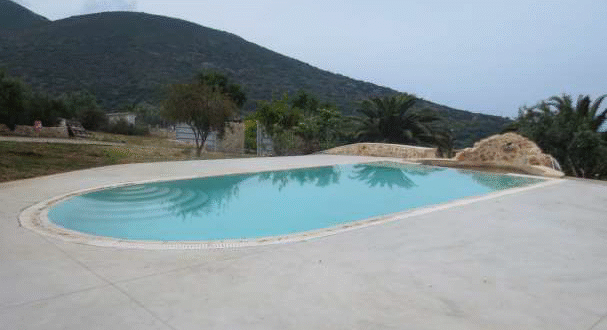
PERMANENT POOL WATERPROOFING (EXISTING CONSTRUCTION) WITH PENETRON® INTEGRAL CAPILLARY WATERPROOFING OR WITH CEMENT BASE POLYMER MODIFIED WATERPROOFING COATING
INTRODUCTION:
Existing concrete swimming pools, are called those, that are fully constructed with landscaped garden or surrounding surfaces (covered with tile, wood, marble, etc.) or bordering with other concrete constructions, such as building, basements, garages, tunnels, etc. Also, there are incomplete pools with existing concrete walls, or, in some cases, with cementitious screed layer, but without a finished surface (tiles, paint, etc.).
I. Pool waterproofing in the existing concrete surface
- Repairing and waterproofing of honeycombed areas, tie holes and pointing applications, with the crystalline waterproofing system of the liquid applied, PENETRON® and the repairing PENECRETE MORTAR® and repair of cracks with running water with the crystalline waterproofing rapid set waterplug, PENEPLUG®.
Depending on the working procedures, concrete surface can be treated and cleaned by a high-pressure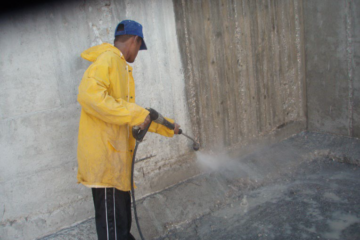 jet water blasting (300-500 bar), for better visual contact with faulty areas.
Then, the water leaking cracks can be sealed with the rapid-setting crystalline waterproofing plug PENEPLUG® (mix with minimum water until the texture is as dry-earth). For a better application of PENEPLUG®, cracks should be routed out with mechanical means, up to 2 – 3 cm in width, in a conical shape, for better anchoring of the rapid-setting plug, during the application. Cold joints can be treated in a similar way, by cutting on both sides of the joint with mechanical means and creating a wedge, 3 cm in width. Next, rapid-setting plug PENEPLUG® is applied.
In some cases, depending on the work schedule, PENEPLUG® can be used as a waterplug,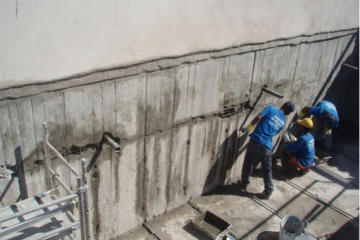 prior to water blasting, but only after PENEPLUG® has reached its mechanical strength. It must be pointed out, that 1 – 2 layers of the integral crystalline waterproofing coating PENETRON®, at a mixing ratio of 5 parts PENETRON® powder to 3-3.5 parts water (by volume), must be applied on PENEPLUG®, by brush, while the latter is still “tacky” and the total consumption of PENETRON® mixture is 1.5 kg/m2 in total for 2 layers (depending on the surfaces, the indicative consumption should be between 1.1 to 1,6 kg / m2)
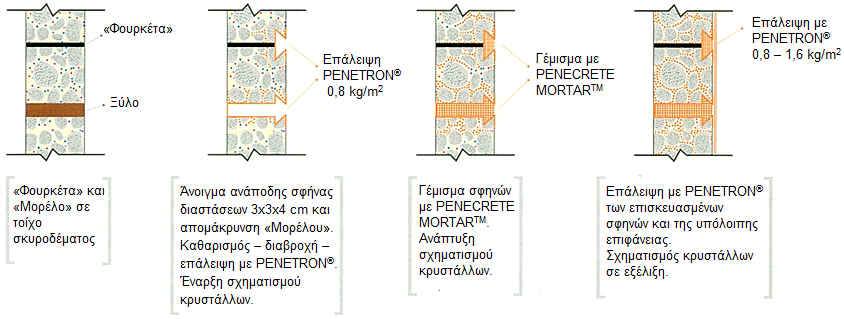
Cracks, honeycombed and spalled areas of new or existing concreting, should be routed out with mechanical means, to remove dirt, loose materials and aggregates. Tie holes must be repaired, as follows. Areas should be chiseled back to sound concrete, by mechanical means and an area of 1.4’’ (35 mm) around them and ¾’’ – 1.2’’ (20 -30 mm) in depth. Metal formworks must be saw cut in ¾’’ (20 mm) in depth. Wooden formworks must be removed completely or routed out at a reverse wedge of 1.2’’x1.2’’x1.6’’ (30 x 30 x 40 mm). Clean honeycombed or spalled areas and holes with excess water, to remove loose materials and moisten the surface to a dull dampness, which is prerequisite for the application of the liquid applied integral crystalline waterproofing coating, PENETRON®, and crystalline waterproofing mortar, PENECRETE MORTAR®. areas. When PENECRETE MORTAR® has been set, but is still moist, apply a second layer of PENETRON® slurry coat, on the repaired areas
- Application of Penetron® integral capillary waterproofing system.
It is possible to apply liquid integral crystalline waterproofing coating,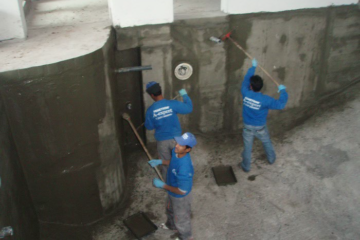 PENETRON®, either in the internal or the external surface of the pool (required excavation of the surrounding area of the pool). Alternatively, the application of SEALCOAT™ FLEX (22.68 kg PENETRON® SEALCOAT with the mixing of 4 kg PENECRYL™ ELASTIC and 3 kg water, with fiberglass mesh reinforcement or not) is possible, in the external surface of the pool. Furthermore, the application of two components polyurethane/asphalt elastomeric resin PENECOAT™ HYPER ELASTIC BLACK is possible.
After the application of PENETRON® SYSTEM, the wetting of PENETRON® for 1-2 days is necessary, in order to activate the crystal growth system. PENETRON® should be cured sufficiently. According to general directives for cement curing, PENETRON® SYSTEM should cure for 10-12 days, prior to water exposal.
- Neutralization
As the application of PENETRON® products on the concrete surface causes the formation of silicic salts, not only in the concrete matrix, but most of the times on the surface of application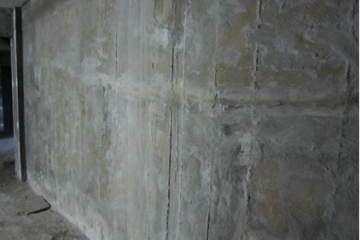 as well (usually after the first 48 hours since application), there is a technical issue, regarding the reduced adhesion of decorative coatings or paints. The problem is treated with the “neutralization” procedure. Neutralization is actually the good “wash” of the surface, approx. after 3 weeks, since the application of PENETRON® products (adequate time for the PENETRON® to act), with a low acidity "aggression" hydrochloric acid (HCl) aqueous solution 3-8% in content or a vinegar solution in water (at a mixing ration 1:3 to 1:10, depending on the vinegar acidity).
During the application, after the surface is cleaned with a vacuum cleaner, use a brush and a plastic pail, containing the solution for the neutralization, “wash” the surface with the solution and after a few minutes, wash the surface with excess water. Then, the surface, after it is dry, can be coated or painted. Alternatively, decorative screeds can be applied within the first 48 hours and before the formation of the silicic acids on the surface. In that case, the time for the coating application is minimized, but the drawback is the inability to control the correct application and the system’s operation. Also, there is always a small possibility for a percent of the formed crystals to penetrate the coatings or screeds and appear on the surface.
- Application of a bonding layer and roughcasting / cementitious mortar to cover the concrete elements and smooth the walls and the bottom of the pool.
At first, a bonding layer is applied on the concrete elements, prior to the application of the cementitious screed for filling. As a bonding layer, either the acrylic resin, PENETRON® ACRYLIC BONDCRETETM or PRIMER STX 100™ can be applied, undiluted, with an indicative coverage of 199.7 ft2/gal (4.9 m2/Lt) or spatterdash, which consists of a mixture of 1 part of cement and 2-3 parts of sand (by volume), diluted in an aqueous solution of 1 part of acrylic resin, PENETRON® LATEX and two parts of water (by volume).
Then, «drivers» are cast, prior to roughcasting/cementitious mortar application. «Drivers» and roughcasting consist of 1 part of cement and 3 parts of sand (by volume), diluted in an aqueous solution of 1 part of acrylic resin, PENETRON® LATEX and two or three parts of water (by volume). The addition of polypropylene fibers is highly recommended, to avoid cracking. The cement percent of both the mixtures is 400-500 kg/m3. PENETRON ADMIX® P (0.8 – 1%) can be added as well. Provided that the weight measurements are accurate, the consumption of 0.8% by weight of cement of PENETRON ADMIX® P is sufficient and secure quantity.
NOTE: In all previous application, avoid the use of limestone.
- Finishing cementitious screed layer (fine or grater).
After the application of the cementitious mortar (roughcasting) on the walls and bottom surface of the pool for smoothing, follows, most of the times, a fine layer of cementitious screed, with fine-grade aggregates and thorough finishing. This application is important, especially when a polyurethane coating for pools is applied (PENECOATTM POOL).
This fine finishing cementitious screed layer consists of common materials, such as fine graded sand and quartz aggregates and high cement concentration (>400 kg/m3). Alternatively, PENETRON® TOP FINISH FINE, finishing topping cement mortar with polymers and fine graded quartz aggregates can be applied, in an indicative consumption of 8.4 lb/ft2 per inch thickness (1.6 kg/m2 per mm thickness), usually in grey or white color. The use of the acrylic resin, PENETRON® ACRYLIC BONDCRETETM, as a primer, is recommended.
- Application of PENEBAR® SW in pipes and pool accessories.
In most applications with ceramic tiles as a finish layer, the waterproofing of the surface, prior to tile application, is recommended. The two component liquid-applied waterproofing coating, SEALCOAT™ FLEX [flexible system of 50 lb (22.68 kg) PENETRON® SEALCOAT diluted in 8.8 lb (4 kg) PENECRYLTM ELASTIC and 6.6 lb (3 kg water)] or SEALCOAT™ ELASTIC [elastic system of 50 lb (22.68 kg) PENETRON® SEALCOAT diluted in 26.5 lb (12 kg) PENECRYLTM ELASTIC] can be used, regarding the demands of the application, which is crack bridging of capillary cracks.
Apply uniformly a slurry coat of SEALCOAT™ FLEX or SEALCOAT™ ELASTIC, with a nap roller. The next day, apply a vertical second layer. The coverage is approx. 0,4 lb/ft2 (2 kg/m2) in two layers, for SEALCOAT™ FLEX and approx. 0.5 lb/ft2 (2.5kg/m2) in two layers, for SEALCOAT™ ELASTIC. Furthermore, the SEALCOAT™ SYSTEMS can be reinforced with a fiberglass grid between layers (mesh 5x5 mm). In that type of application, place the grid on the first layer, while wet, and fully cover the grid with the second layer, on the next day. The use of fiberglass grid is expected to increase the total coverage of the system up to approx. 0.6 lb/ft2 (3 kg/m2) in 2 layers.
If the cementitious screed layer has no cracks, the application of SEALCOAT™ FLEX is possible. In case there are many cracks in the surface, SEALCOAT™ ELASTIC should be applied. In order to place ceramic tiles on top of SEALCOATTM SYSTEMS, use an appropriate FLEX type adhesive paste, for pool application
- Application of PENEBAR® SW in pipes and pool accessories.
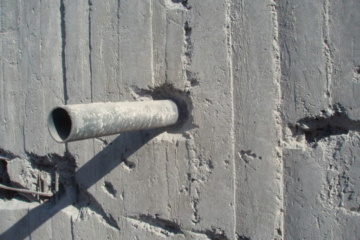
In case of pipes application, the sealing/waterproofing of the pipes’ perimeter with PENEBAR® SW is necessary (usually PENEBAR® SW 55 TYPE B or half of PENEBAR® SW 55 TYPE B is suggested). The PENEBAR® SW should be put in 5 cm depth and covered with rapid setting integral crystalline cementitious waterstop, PENEPLUG®.
NOTEThe circumferential cavity for the PENEBAR® SW expanding strip application, which will be covered with
PENEPLUG®, must be routed out at a reverse wedge for better anchoring of the mortar.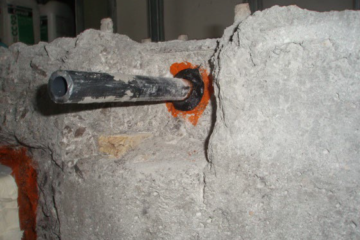
Waterproofing and repairing of existing pool failures with tiles or chipping in the topping surface.
A. In case there are failures in the topping surface of the existing pool, with tiles or chippings, cracks and water loss, the tiles or chippings should be removed and the cracks should be repaired with repairing mortar.
1A. Dismantling of tiles or chippings and checking of cementitious screed layer.
First of all, the dismantling of tiles or chippings, or the removal of colors and the check of cementitious screed layer for failures is required. If the cementitious screed layer is healthy, the surfaces to be treated must be clean and sound, free of dirt and any other contaminant, that will act as a bond breaker of repairing mortars. Surface must be saturated with water, without any standing or puddled water. If needed, apply a bonding agent, PENETRON® ACRYLIC BONDCRETE, to enhance bonding properties, before PENETRON® MULTI PATCH or PENETRON® ACRYLIC PATCH application. PENETRON® MULTI PATCH requires 3,1 to 3,4 kg of clean water per bag, while PENETRON® ACRYLIC PATCH requires 4,7 to 5 kg clean water per bag. For thickness over 5 cm, add 25% by weight of PENETRON® ACRYLIC PATCH, QUARTZ SAND MIX diameter up to 1 cm. For quick repair of concrete with hydrostatic pressure, apply the highly accelerated underwater cement, PENETRON® WATERPLUG RAPID. Apply immediately after mixing. As soon as PENETRON® WATERPLUG RAPID has achieved a dry, putty texture and a compatible shape, or a dry pack (dry earth) consistency, depending on the application, force the material into the crack or cavity, compressing it firmly, using a gloved palm, trowel, wood block, or other flat object. Hold it in place for over a minute. If there is a strong water flow, hold for six minutes. Do not brush or trowel over surface. Shave off excess material with a knife or other similar sharp tool.
2A. Waterproofing of the concrete surface with the conventional systems SEALCOATTM FLEX or SEALCOATTM ELASTIC.
In most applications with ceramic tiles as a finishing layer, the waterproofing of the surface, prior to tile application, is recommended.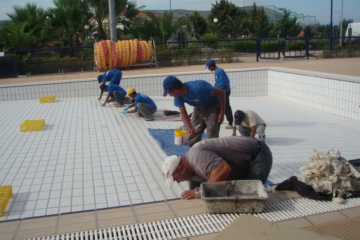 The two component, liquid-applied, waterproofing coating, SEALCOAT™ FLEX [flexible system of 50 lb (22.68 kg) PENETRON® SEALCOAT diluted in 8.8 lb (4 kg) PENECRYLTM ELASTIC and 6.6 lb (3 kg water)], or SEALCOAT™ ELASTIC [elastic system of 50 lb (22.68 kg) PENETRON® SEALCOAT diluted in 26.5 lb (12 kg) PENECRYLTM ELASTIC] can be used, regarding the demands of the application, which is crack bridging of capillary cracks.
Apply uniformly a slurry coat of SEALCOAT™ FLEX or SEALCOAT™ ELASTIC, with a nap roller. The next day, apply a vertical second layer.
The coverage is approx. 0,4 lb/ft2 (2 kg/m2) in two layers, for SEALCOAT™ FLEX and approx. 0.5 lb/ft2 (2.5kg/m2) in two layers, for SEALCOAT™ ELASTIC.
Furthermore, the SEALCOAT™ SYSTEMS can be reinforced with a fiberglass grid between layers (mesh 5x5 mm). In that type of application, place the grid on the first layer, while wet, and fully cover the grid with the second layer, on the next day.
The use of fiberglass grid is expected to increase the total coverage of the system up to approx. 0.6 lb/ft2 (3 kg/m2) in 2 layers.
If the cementitious screed layer has no cracks, the application of SEALCOAT™ FLEX is possible. In case there are many cracks in the surface, SEALCOAT™ ELASTIC should be applied.
In order to place ceramic tiles on top of SEALCOATTM SYSTEMS, use an appropriate FLEX type adhesive paste for pool application.
B. In case there are failures in the topping surface of the existing pool, with tiles or chippings and there are cracks and water loss, the tiles or chippings should be removed, the cracks should be repaired with repairing mortar and the concrete should be repaired with crystalline waterproofing coating.
1B. Stripping the tiles and checking the leveling cement mortar (loose cement mortar).
First of all, the dismantling of tiles or chippings is required or the removal of colors and the checking of cementitious screed layer for failures. If the cementitious screed layer is not healthy, then the dismantling of cementitious screed layer is required, by a high-pressure jet waterblasting (300-500 bar).
Depending on the working procedures, concrete surface can be treated and cleaned by a high-pressure jet waterblasting (300-500 bar), for better visual contact with faulty areas.
Then, the water leaking cracks can be sealed with the rapid-setting crystalline waterproofing plug, PENEPLUG® (mix with minimum water, until the texture is as dry-earth). For a better application of PENEPLUG®, cracks should be routed out with mechanical means, up to 2 – 3 cm in width, in a conical shape, for better anchoring of the rapid-setting plug, during the application.
Cold joints can be treated in a similar way, by cutting on both sides of the joint with mechanical means and creating a wedge, 3 cm in width. Next, rapid-setting plug, PENEPLUG®, is applied.
In some cases, depending on the work schedule, PENEPLUG® can be used as a waterplug, prior to waterblasting, but only after PENEPLUG® has reached its mechanical strength.
It must be pointed out, that 1 – 2 layers of the integral crystalline waterproofing coating, PENETRON®, at a mixing ratio of 5 parts PENETRON® powder to 3-3.5 parts water (by volume), must be applied on PENEPLUG®, by brush, while the latter is still “tacky” and the total consumption of PENETRON® mixture is 1.5 kg/m2 in total for 2 layers (depending on the surfaces, the indicative consumption should be between 1.1 to 1,6 kg / m2).
Tie holes must be repaired, as mentioned below. Areas should be chiseled back to sound concrete, by mechanical means and the area of 1.4’’ (35 mm) around them
and metal formworks must be removed or, at least, sawcut and routed out at a reverse wedge of 1.2’’x1.2’’x1.6’’ (30 x 30 x 40 mm).
Clean areas with excess water, to remove loose materials and moisten the surface to a dull dampness, as mentioned above. When the concrete is damp, with no wet sheen on the surface, apply a slurry coat of the integral crystalline waterproofing coating PENETRON®, on the areas to be patched or repaired and 2/5” (10 mm) around them, at a mixing ratio of 5 parts PENETRON® powder to 3-3.5 parts of water (by volume).
While PENETRON® coating is still “green” (tacky), mix the integral crystalline repairing mortar PENECRETE MORTAR® with adequate amount of water, until the desired consistency is achieved [usual mixing ratio is 4.5 parts of PENECRETE MORTAR® to 1 part of water (by volume)] and fill the cracks and spalled areas.
As mentioned above, when PENECRETE MORTAR® has set, but is still moist, apply a second layer of PENETRON® slurry coat, at a mixing ratio of 5 parts PENETRON® powder to 3-3.5 parts of water (by volume), on the repaired areas. At this stage, if waterproofing of the total construction is required, apply a slurry coat of PENETRON® on the whole surface, in two layers, while the first layer is still “green” (approx. half to one hour later).
In lots of applications, to save time, the first layer of PENETRON® is applied post to surface preparation and dampening and approx. half an hour later, while the product is still “green” and the repairing mortar, PΕΝΕCRETE MORTAR®, is applied. Approx. half to an hour later, and while PΕΝΕCRETE MORTAR® is still “green”, the second layer of PENETRON® slurry coat is applied. The total consumption of the two layers of PENETRON® is 1.5 kg/m2 (depending on the surfaces, the indicative consumption should be between 1.1 to 1,6 kg / m2).
2B. Application of Penetron® integral capillary waterproofing system
It is possible to apply liquid integral crystalline waterproofing coating,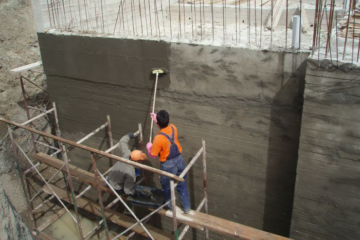 PENETRON®, either in the internal or the external surface of the pool (required excavation of the surrounding area of the pool).
Alternatively, in the external surface of the pool, the application of SEALCOAT™ FLEX (22.68 kg PENETRON® SEALCOAT with the mixing of 4 kg PENECRYL™ ELASTIC and 3 kg water, with fiberglass mesh reinforcement or not) is possible. Furthermore, the application of two components polyurethane/asphalt elastomeric resin, PENECOAT™ HYPER ELASTIC BLACK is possible.
After the application of PENETRON® SYSTEM, the wetting of PENETRON® for 1-2 days is necessary, in order to activate the crystal growth system.
PENETRON® should be cured sufficiently. Accordingly, to general directives for cement curing, PENETRON® SYSTEM should cure for 10-12 days, prior to water exposure.
3B. Neutralization
As the application of PENETRON® products on the concrete surface cause the formation of silicic salts, not only in the concrete matrix, but most of the times on the surface of application as well (usually after the first 48 hours since application), there is a technical issue, regarding the reduced adhesion of decorative coatings or paints.
The problem is treated with the “neutralization” procedure. Neutralization is actually the good “wash” of the surface, approx. after 3 weeks, since the application of PENETRON® products (adequate time for the PENETRON® to act), with a low acidity "aggression" hydrochloric acid (HCl) aqueous solution 3-8% in content or a vinegar solution in water (at a mixing ration 1:3 to 1:10, depending on the vinegar acidity).
During the application, after the surface in cleaned with a vacuum cleaner, use a brush and a plastic pail, containing the solution for the neutralization, “wash” the surface with the solution and after a few minutes, wash the surface with excess water.
Then, the surface, after it is dry, can be coated or painted. Alternatively, for the use of decorative screeds, they can be applied within the first 48 hours and before the formation of the silicic acids on the surface.
In that case, the time for the coating application is minimized, but the drawback is the inability to control the correct application and operation of the system.
Also, in that case, there is always a small possibility for a percent of the formed crystals to penetrate the coatings or screeds and appear on the surface.
4B. Application of a bonding layer and roughcasting / cementitious mortar to cover the concrete elements and smooth the walls and the bottom of the pool.
At first, a bonding layer is applied on the concrete elements, prior to the application of the cementitious screed for filling. As a bonding layer, either the acrylic resin, PENETRON® ACRYLIC BONDCRETETM or PRIMER STX 100™ can be applied, undiluted, with an indicative coverage of 199.7 ft2/gal (4.9 m2/Lt) or spatterdash, which consists of a mixture of 1 part of cement and 2-3 parts of sand (by volume), diluted in an aqueous solution of 1 part of acrylic resin, PENETRON® LATEX and two parts of water (by volume).
At first, a bonding layer is applied on the concrete elements, prior to the application of the cementitious screed, for filling. As a bonding layer, either the acrylic resin PENETRON® ACRYLIC BONDCRETETM or PRIMER STX 100™ can be applied, undiluted, with an indicative coverage of 199.7 ft2/gal (4.9 m2/Lt) or spatterdash, which consists of a mixture of 1 part of cement and 2-3 parts of sand (by volume), diluted in an aqueous solution of 1 part of acrylic resin, PENETRON® LATEX and two parts of water (by volume).
Then, «drivers» are cast, prior to roughcasting/cementitious mortar application. «Drivers» and roughcasting consist of 1 part of cement and 3 parts of sand (by volume), diluted in an aqueous solution of 1 part of acrylic resin, PENETRON® LATEX and two or three parts of water (by volume).
The addition of polypropylene fibers is highly recommended, to avoid cracking. The cement percent of both the mixtures is 400-500 kg/m3. PENETRON ADMIX® P (0.8 – 1%) can be added as well. Provided that the weight measurements are accurate, the consumption of 0.8% by weight of cement of PENETRON ADMIX® P is sufficient and secure quantity.
NOTE: In all previous applications lime is never used.
5B. Finishing cementitious screed layer (fine or grater).
In most applications with ceramic tiles as a finishing layer, the waterproofing of the surface, prior to tile application, is recommended.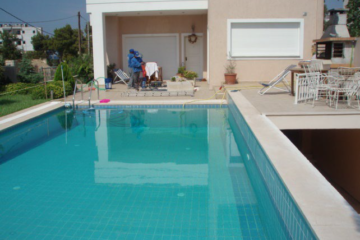 The two component, liquid-applied, waterproofing coating, SEALCOAT™ FLEX [flexible system of 50 lb (22.68 kg) PENETRON® SEALCOAT diluted in 8.8 lb (4 kg) PENECRYLTM ELASTIC and 6.6 lb (3 kg water)], or SEALCOAT™ ELASTIC [elastic system of 50 lb (22.68 kg) PENETRON® SEALCOAT diluted in 26.5 lb (12 kg) PENECRYLTM ELASTIC] can be used, regarding the demands of the application, which is crack bridging of capillary cracks.
Apply uniformly a slurry coat of SEALCOAT™ FLEX or SEALCOAT™ ELASTIC, with a nap roller. The next day, apply a vertical second layer.
The coverage is approx. 0,4 lb/ft2 (2 kg/m2) in two layers, for SEALCOAT™ FLEX and approx. 0.5 lb/ft2 (2.5kg/m2) in two layers, for SEALCOAT™ ELASTIC.
Furthermore, the SEALCOAT™ SYSTEMS can be reinforced with a fiberglass grid between layers (mesh 5x5 mm). In that type of application, place the grid on the first layer, while wet, and fully cover the grid with the second layer, on the next day.
SEALCOAT™ SYSTEMS with fiberglass mesh (5×5 mm square). In this case, place the fiberglass mesh on the fresh first layer and completely cover the mesh with the second layer, the next day.
The use of fiberglass grid is expected to increase the total coverage of the system up to approx. 0.6 lb/ft2 (3 kg/m2) in 2 layers.
Usually, if it is considered that the cement leveling mortar does not present problems or cracks, the SEALCOATTM FLEX system is applied, for better adhesion of the adhesive to the surface or in special cases where it is necessary to bridge larger cracks on the mortar surface, the SEALCOATTM FLEX system is applied.
Application of PENEBAR® SW in pipes and pool accessories.
In the case of subsequent installation of components or pipes that require perimeter sealing/waterproofing, the corresponding perimeter installation of PENEBAR® SW hydro-swellable cords is recommended (recommended controlled swelling type PENEBAR® SW 55 TYPE B or often half of type 55 B).
The PENEBAR® SW should be put in 5 cm depth and covered with rapid setting integral crystalline cementitious waterstop, PENEPLUG®.
NOTEThe circumferential cavity for the PENEBAR® SW expanding strip application, which will be covered with PENEPLUG®, must be routed out at a reverse wedge for better anchoring of the mortar.
III. Waterproofing and repairing of existing pool failures, with color in the topping surface.
A. In case there are failures in the topping surface of the existing pool with tiles or chippings and there are cracks and water loss, the tiles or chippings should be removed and the cracks should be repaired, with repairing mortar.
1A.Color removal and checking of cementitious screed layer.
Initially, the paint is removed and the cementitious leveling mortar is checked for any failures. If the cementitious leveling mortar is sound, the surface is cleaned of loose or contaminating factors that can negatively affect the adhesion of the repair materials and the substrate is soaked to saturation with water.
Then, either the general concrete repair mortar PENETRON® MULTI PATCH, or the early strength development mortar with modified polymers PENETRON® ACRYLIC PATCH, is applied, using the acrylic adhesion promoter PENETRON® ACRYLIC BONDCRETETM to stabilize the substrate and increase adhesion, where necessary.
PENETRON® MULTI PATCH requires 3.1 kg to 3.4 kg of clean water per 25 kg of mortar and PENETRON® ACRYLIC PATCH requires 4.7 L to 5 L of clean water per 22.68 kg of mortar.
For the repair of large cavities (larger than 50 mm fillings), add aggregates of up to 1 cm in size to PENETRON® ACRYLIC PATCH. The percentage of aggregates added should not exceed 25% by weight of PENETRON® ACRYLIC PATCH.
For repairs subject to hydrostatic pressure and active leaks, the rapid-setting conventional repair mortar PENETRON® WATERPLUG RAPID is applied.
Immediately after mixing in the appropriate proportion, once PENETRON® WATERPLUG RAPID has a plastic or «earthenstone» texture, depending on the application, the material is applied with force to the repair site, pressing it firmly by hand, with a trowel or other flat object.
Press firmly for over a minute. In case of heavy water flow, press for about 6 minutes. Remove excess material with a knife or any sharp object. Do not use a trowel or brush. The final surface of the repairs is finished with appropriate means, until a smooth surface is achieved.
2A. Waterproofing of the concrete surface with the conventional systems SEALCOATTM FLEX or
SEALCOATTM ELASTIC.
After the smoothing layer with cement mortar ("slurry"), most often a thin layer of mortar with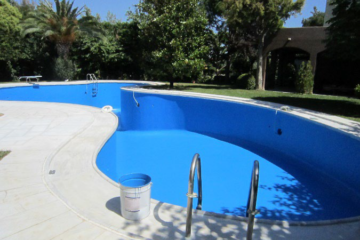 fine aggregates and very good finish. Especially in cases where pool painting follows (PENECOATTM POOL).
This fine finishing cementitious screed layer consists of common materials, such as fine graded sand and quartz aggregates and high cement concentration (>400 kg/m3). Alternatively, PENETRON® TOP FINISH FINE, finishing topping cement mortar with polymers and fine graded quartz aggregates can be applied, in an indicative consumption of 8.4 lb/ft2 per inch thickness (1.6 kg/m2 per mm thickness), usually in grey or white color. The use of the acrylic resin, PENETRON® ACRYLIC BONDCRETETM, as a primer, is recommended.
B. In case there are failures in the topping surface of the existing pool, with tiles or chippings and there are cracks and water loss, the tiles or chippings should be removed, the cracks should be repaired with repairing mortar and the concrete should be repaired with crystalline waterproofing coating.
1B. Removal of paint and control of leveling cement mortar (loose cement mortar).
First of all, remove colors and check of cementitious screed layer for failures. If the cementitious screed layer is not healthy, then the dismantling of cementitious screed layer is required, by a high-pressure jet waterblasting (300- 500 bar). Depending on the working procedures, concrete surface can be treated and cleaned by a high-pressure jet waterblasting (300-500 bar), for better visual contact with faulty areas.
Then, the water leaking cracks can be sealed with the rapid-setting crystalline waterproofing plug PENEPLUG® (mix with minimum water until the texture is as dry-earth). For a better application of PENEPLUG®, cracks should be routed out with mechanical means, up to 2 – 3 cm in width, in a conical shape, for better anchoring of the rapid-setting plug, during the application. Cold joints can be treated in a similar way, by cutting on both sides of the joint with mechanical means and creating a wedge, 3 cm in width. Next, rapid-setting plug PENEPLUG® is applied.
In some cases, depending on the work schedule, PENEPLUG® can be used as a waterplug, prior to waterblasting, but only after PENEPLUG® has reached its mechanical strength. It must be pointed out, that 1 – 2 layers of the integral crystalline waterproofing coating PENETRON®, at a mixing ratio of 5 parts PENETRON® powder to 3-3.5 parts water (by volume), must be applied on PENEPLUG®, by brush, while the latter is still “tacky” and the total consumption of PENETRON® mixture is 1.5 kg/m2 in total for 2 layers (depending on the surfaces, the indicative consumption should be between 1.1 to 1,6 kg / m2).
After the application of PENETRON® SYSTEM, the wetting of PENETRON® for 1-2 days is necessary, in order to activate the crystal growth system. PENETRON® should be cured sufficiently. According to general directives for cement curing, PENETRON® SYSTEM should cure for 10-12 days, prior to water exposal.
NOTE: In all the previous applications, lime is never used.
After the application of the cementitious mortar (roughcasting) on the walls and bottom surface of the pool for smoothing, follows, most of the times, a fine layer of cementitious screed, with fine-grade aggregates and thorough finishing. This application is important, especially when a polyurethane coating for pools is applied (PENECOATTM POOL).
This fine finishing cementitious screed layer consists of common materials, such as fine graded sand and quartz aggregates and high cement concentration (>400 kg/m3). Alternatively, PENETRON® TOP FINISH FINE, finishing topping cement mortar with polymers and fine graded quartz aggregates can be applied, in an indicative consumption of 8.4 lb/ft2 per inch thickness (1.6 kg/m2 per mm thickness), usually in grey or white color. The use of the acrylic resin, PENETRON® ACRYLIC BONDCRETETM, as a primer, is recommended.
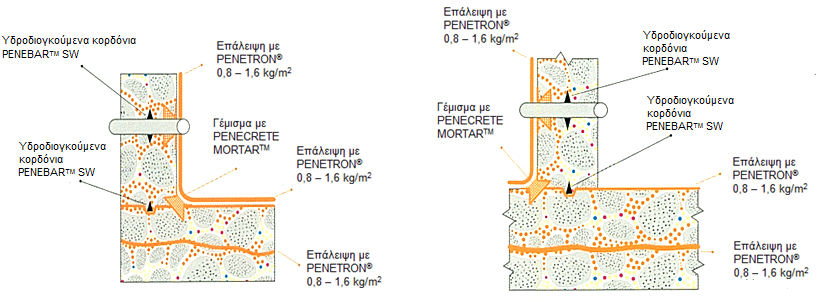
In case of pipes application, the sealing/waterproofing of the pipes’ perimeter with PENEBAR® SW is necessary (usually PENEBAR® SW 55 TYPE B or half of PENEBAR® SW 55 TYPE B is suggested). The PENEBAR® SW should be put in 5 cm depth and covered with rapid setting integral crystalline cementitious waterstop, PENEPLUG®.
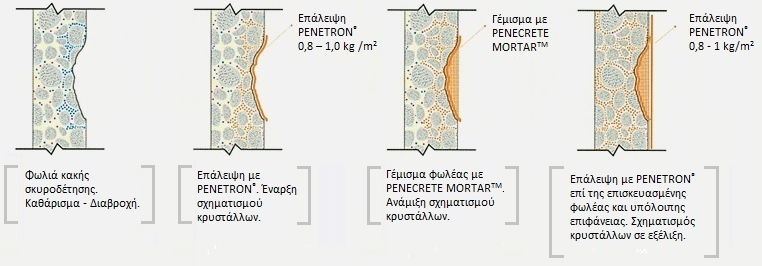
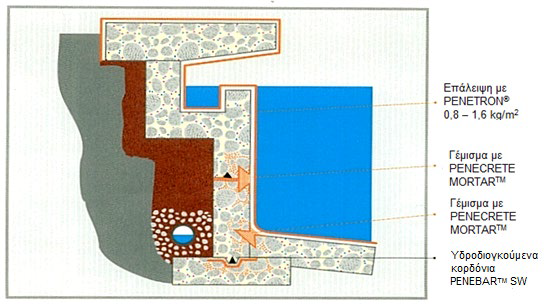
A schematic description of repaired services with PENETRON® integral crystalline waterproofing system of PENETRON INTERNATIONAL LTD is depicted below: The

No Comments